Assets
An asset is a thing you hold. Whose side it is on is a separate, changeable fact layered on top of it.
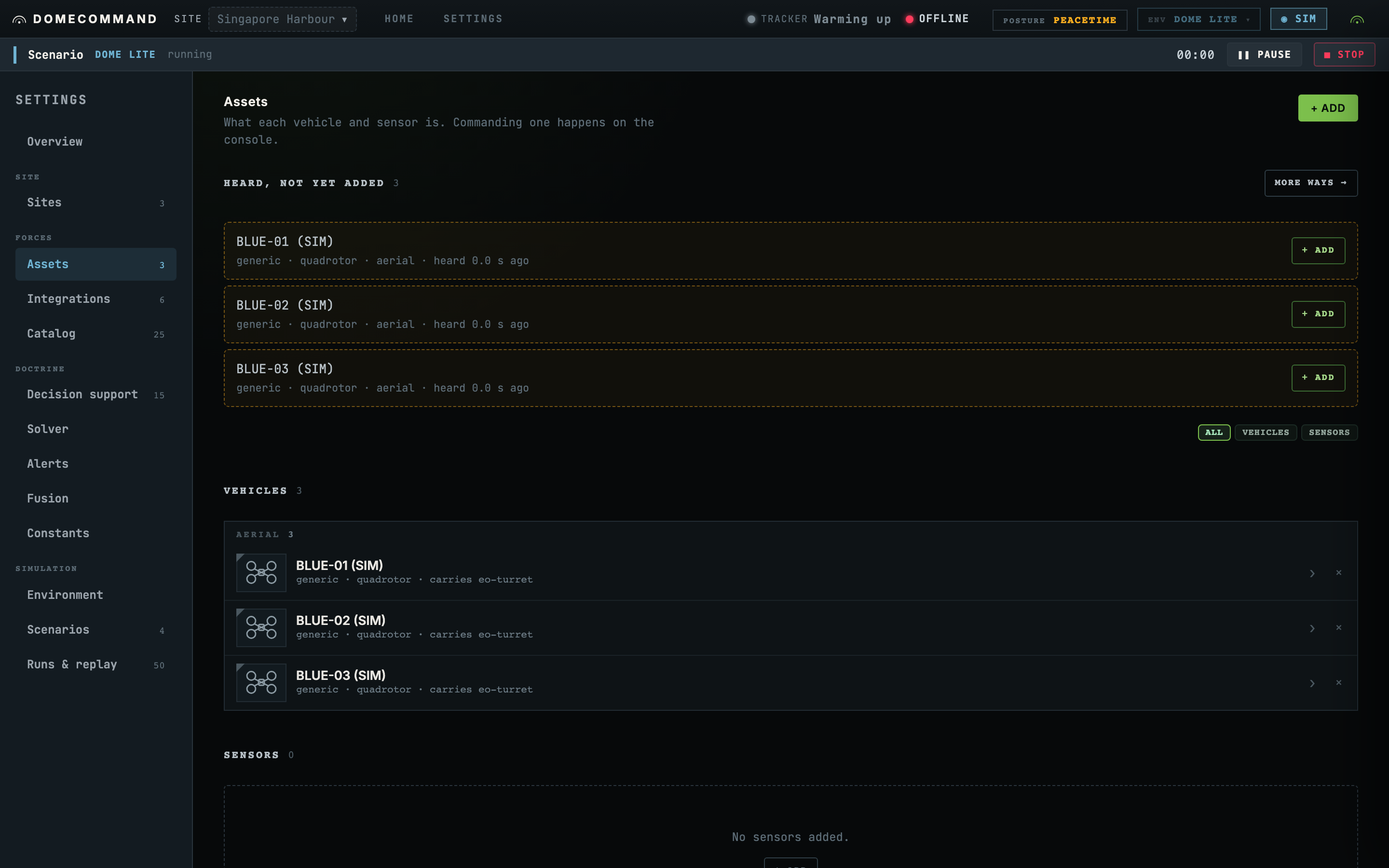
An asset is one platform in your inventory. It is one of three kinds:
- a vehicle, which flies, drives or sails
- a sensor, which measures something
- a protected thing, which is a place you defend rather than something you add
Affiliation
The same airframe can be yours today and a contact tomorrow. So an asset carries no side. Affiliation is an assignment layered on top, with its own lifetime, and it can change without the platform changing.
That matters in one specific way: a detection whose Remote-ID serial matches an asset carrying an active friendly assignment is classified friendly and marked do-not-engage. Everything else is interpreted dynamically. Identity comes from the registry; the picture does not guess.
Domains
Every asset has a domain: aerial, ground, maritime or electronic warfare. It is not a label and not just a grouping. It decides which questions the configuration surface is entitled to ask.
| Domain | Asked for |
|---|---|
| Aerial | endurance, cruise, max speed, ceiling, battery |
| Ground | range, cruise, max speed, battery |
| Maritime | endurance, cruise, max speed, battery |
| Electronic warfare | nothing |
A ground rover shown an endurance field in flight minutes is being asked a question with no answer, and the field then renders empty forever. That is a wrong form rather than missing data, so the fix is the question set.
EW asks nothing because a mast is mains-powered. There is no endurance to declare, no speed, and therefore no row that could only ever read blank.
The words change with the domain even where the stored value does not. A ground vehicle's cruise is a ground speed and an aircraft's is an airspeed. What varies is the question, not the quantity.
Commands an asset accepts
An asset's card shows the verbs that asset actually advertises, not every verb its protocol makes possible. A MAVLink integration can carry eight commands; a particular airframe on it may accept six.
This is why a simulated twin of a real asset shows the same buttons. The twin exists to behave like the thing, and a twin missing TAKEOFF would defeat that.
Where the specifications come from
Everything parametric comes from the catalog: how far it flies, how long it stays up, how far a sensor reaches, how wide it looks. You choose a product; you do not fill in a specification. See Catalog & asset types.
Where to go next
- Onboarding an asset to get one in.
- Catalog & asset types for where the numbers come from.