Sensor fusion
Radar, RF, EO/IR and acoustic each see a different slice. Fusion resolves them into one contact with one identity and a confidence you can act on.
A counter-UAS site is never short of sensors. It is short of agreement. A radar return, a radio emitter, a thermal blob and a propeller signature can all be the same drone, or four different things.
What each sensor is blind to
Each kind is strong exactly where another is blind.
| Sensor | Sees | Blind to |
|---|---|---|
| Radar | Range, bearing and speed at distance | Small low-signature quadcopters; clutter near terrain |
| RF | Control and video links, often before the drone is visible | Autonomous drones that do not transmit |
| EO/IR | Visual and thermal confirmation, and a close-up identity | Distance; weather, smoke, darkness without thermal |
| Acoustic | Rotors at short range | Anything past a few hundred metres; wind and clutter |
Fusion branches on the measurement
Fusion branches on what a sensor measured, never on which sensor it was.
There is no RF algorithm and no acoustic algorithm. There are three measurement kinds.
| Kind | Who reports it | What fusion does |
|---|---|---|
| Position | Radar, LIDAR, a geolocated camera plot | Cluster, associate, update the filter |
| Bearing only | RF direction-finding, an acoustic array, an EO/IR turret | Triangulate against another ray, or apply a single-ray angle update |
| Cooperative ID | Remote-ID, ADS-B, own telemetry | The identity channel, kept separate from the kinematic picture |
Per-sensor differences are data, not code. Accuracy, probability of detection, field of view and reach live in one place and reach the filter through the observation itself. A new bearing-only modality needs no fusion code at all.
The practical consequence is that adding a sensor class is a configuration change. A new acoustic array or a new direction-finder needs its accuracy, its reach and its field of view declared, and nothing else.
Bearing-only sensors
This is worth sitting with, because it changes how a site is laid out.
One direction-finder gives you a ray. A drone somewhere along it. Two direction-finders give you an intersection. That is why two cheap nodes are often worth more than one expensive one, and why a sensor's reach matters less than what it measures.
The supported hardware table names the measurement for every sensor, because it is the number that decides whether it can carry a track on its own.
Existence and identity
Corroboration buys existence. Three sensors agreeing that something is there makes it very likely something is there.
Corroboration does not buy identity. Three sensors that all guessed from kinematics have not seen anything. Kinematics alone can never reach hostile, and the ceiling that enforces this is doctrine rather than a tuning parameter.
The fact that lifts it is visual ID, and it is deliberately strict: an imager has produced a picture of the contact and the fused class is in the UAS family. Either half alone is what the ceiling exists to refuse. A camera that saw a bird, or a radar that guessed a multirotor.
Confidence and its evidence
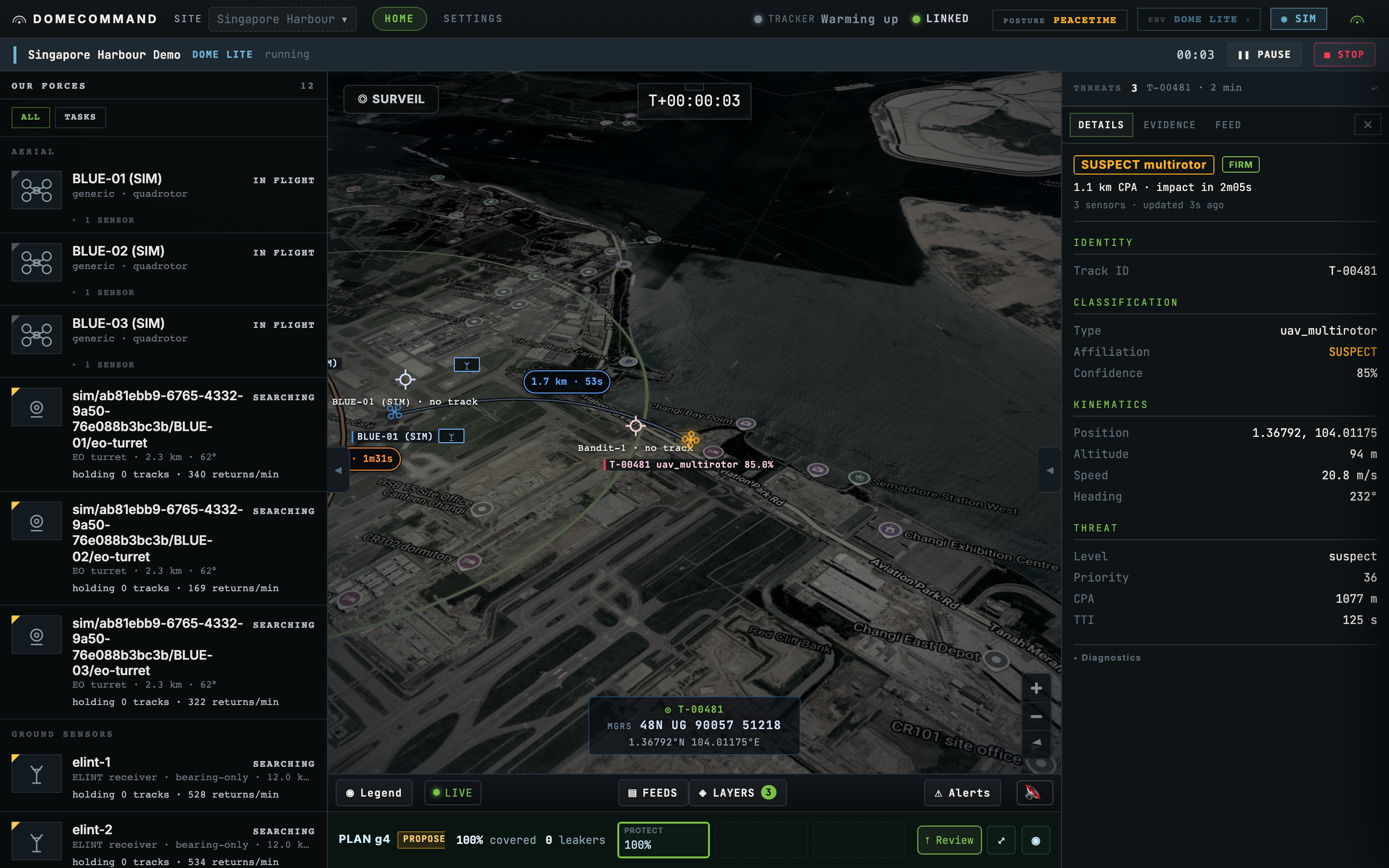
A contact confirmed this second by radar, camera and RF is a different thing from a faint, minutes-old return from one sensor. The picture never pretends otherwise, and the evidence behind a number is one click away.
Fusion constants
Fusion constants live on their own page, one block per algorithm, because each algorithm brings its own.

Where to go next
- Onboarding an asset to connect your own sensors.
- How it works to follow the fused track onwards.