Zones
A zone is not an annotation on a map. Each category is read by something that changes what the system does.
A zone is a named, categorised, shaped area. The shape is a circle or a polygon. The category is semantic: the system reads it and behaves differently. Tags are yours, for filtering and grouping, and nothing acts on them.
Getting that split right is most of what makes zones useful. A category you invent is a zone nothing reads.
The eight categories
| Category | What reads it |
|---|---|
| Boundary | The operating geofence. Sets the extent, and raises a reflexive alert on breach. |
| Keep-out | A hard constraint on the solver. No kinetic effect inside, ever. |
| No-go | A navigation constraint on your own aircraft. They will not enter. |
| GPS-denied | Aircraft inside read their navigation as degraded. |
| Jam | RF-denied. Mesh and uplink degrade inside. |
| Free-fire | A fact the rules read rather than a switch: membership feeds doctrine. This one is ROE. |
| ISR-priority | The coverage objective. Weighted, so the planner spends sensing here. |
| Corridor | An approved transit lane, used for deconfliction. |
Keep-out and free-fire are the two people confuse. Keep-out forbids an effect. Free-fire permits one. They are opposite, and a site usually has both.
Two categories take a knob: ISR-priority takes a weight, which is how much coverage there is worth relative to elsewhere. Jam and GPS-denied take a strength from 0 to 1, which is how complete the denial is.
Drawing a zone
Settings → Sites → (a site) → Add zone. The map is the field.
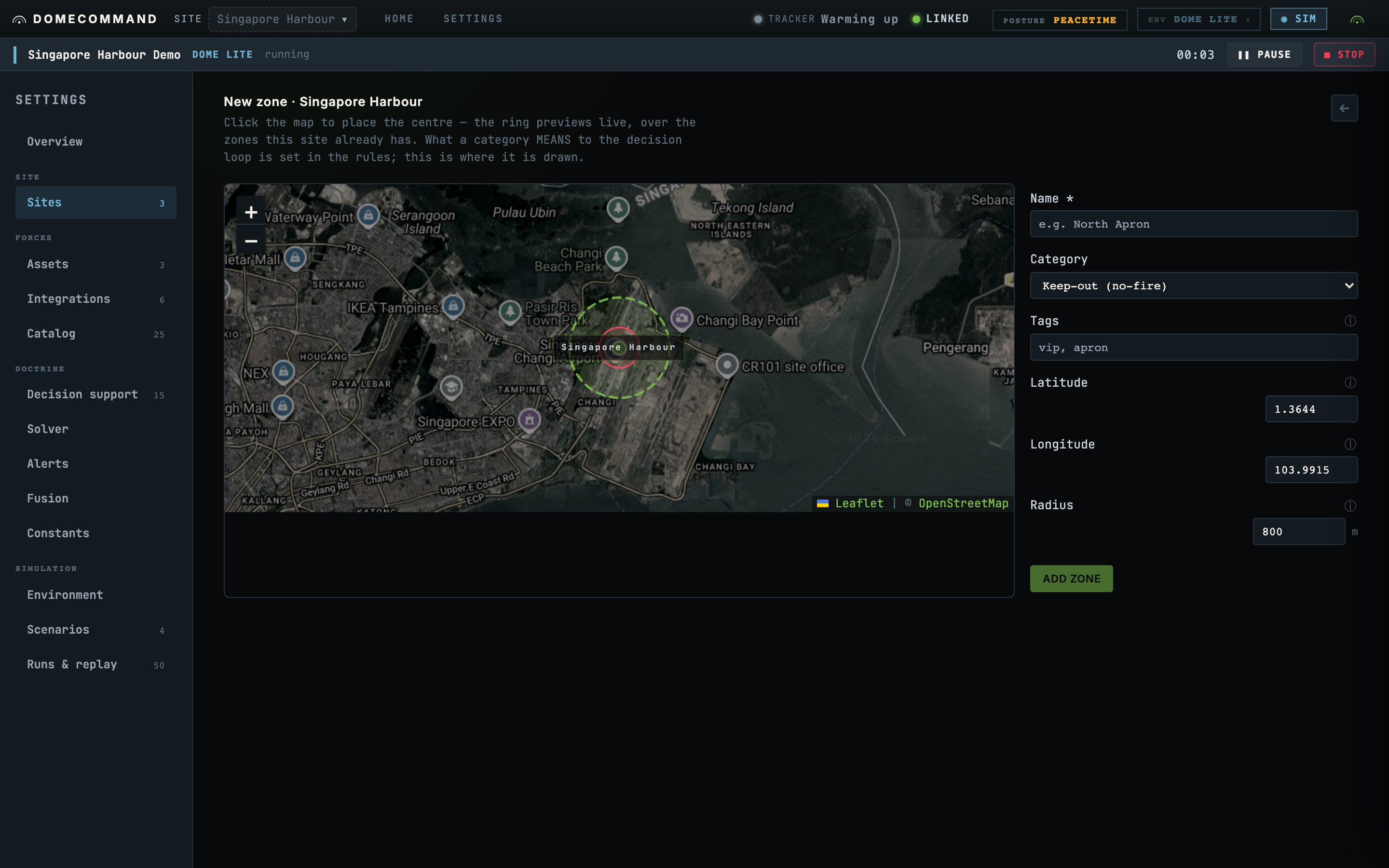
Latitude, longitude and radius stay as typed readouts, because a surveyed coordinate has to be enterable. They are the secondary control rather than the only one.
Zones and rules
A zone says where. It does not say what happens there. That is a rule, and rules read zone membership as a fact they can test.
Two facts a rule can test: whether a track is inside a kind of zone (any keep-out), and
whether it is inside one named zone (west-sector). The first is how you write doctrine
that applies everywhere; the second is how you write the exception.
A shipped rule uses the first: designate a track SUSPECT when it is inside a keep-out zone and its affiliation is not friend. See Policy & rules.
Where to go next
- What is an asset for the things you place inside these shapes.
- Policy & rules for what reads zone membership.